- June–August:Clearest, driest months in the park
- 8°C / 23°C:Average high at the cable car base, January and July
- Before 10:00:Arrive then to beat the car park rush
- Dec–Mar:Snow season, when roads can close
- June:When the red tajinaste usually flowers
When Should You Visit Mount Teide?
The short answer
Teide National Park is open every day of the year and Teide tours are available year-round, although winter snow can close the roads into the park for a day or more. What you see depends first on the weather on the day. Strong wind can stop the cable car at short notice, and cloud or Saharan dust haze can hide the view, so check the forecast for the park, not your resort.
If your dates are flexible, June to August offers the best overall balance: the clearest, driest weather in the park, with average highs of about 19 to 23°C at cable car base height, mild enough for a day outdoors. June is the month to choose, because the red tajinaste, a tall flower spike found only in this park, usually flowers then. May and September come next: still dry, but with about a third fewer clear days.
No season was much quieter in 2025: the park’s visitors were spread almost evenly across the year. The main car parks are usually full from about 10:00 to 15:00, so arrive when the cable car opens at 9:00, or skip the cable car and come late in the day for sunset and the stars.
Snow can cover the peak mainly from December to March, when highs at the cable car base average only 8 to 10°C, so dress for real cold.
Whatever month you visit, check the cable car status that morning, and from November to April the road status too.
- Best overall, flexible dates:
- June to August, but strong sun at altitude
- One month to choose:
- June, when the tajinaste usually flowers
- Next best months:
- May and September, but fewer clear days
- Snow on the peak, if you are lucky:
- December to March, but roads can close
- Fewer people, any month:
- Before 10:00 or after 15:00
- Time of day:
- Early morning or sunset
- Most important live checks:
- Wind · cloud · rain and snow · cable car status
- 8°C / 23°C: Average high at the cable car base in January and July; the top station is colder, so bring a warm layer in any month
- 27 / 11 days: Clear days in an average July and December, so summer gives the best chance of a clear view
- 24–26%: Share of the park’s 2025 visitors in each season, so plan around the hour rather than the month
Check Availability & Prices
Sunset and Stargazing at Teide National Park runs in every month and arrives after the daytime crowds have gone: sunset from a viewpoint above the clouds, then telescopes under the park’s Starlight Reserve sky. Pick a night near the new moon if you can.
Check Your Date: Cable Car, Forecast, Sunset and Moon
Pick your day to see the cable car hours, the weather in the park, sunset and the moon. Up to about two weeks ahead it reads a live model forecast for the park; further out it describes a typical day in that month.
The Teide year at a glance
Pick a date to see the cable car hours and the forecast, or the typical weather, in the park.
- Cable car: opens at 9:00 every day except 25 December; closes for wind or ice
- Snow and ice: most likely from December to March; heavy snow can close the roads
- Sunset in the park: from just after 18:00 in December to just after 21:00 in late June
- Moon for stargazing: choose a night near the new moon for the darkest sky
Check day tours with the cable car
The forecast is a computer model for the park between 9:00 and 18:00, with gusts read at the height of the upper station. Volcano Teide does not publish a wind limit for the cable car, so the gust levels here are descriptive; for the official word on the day, read Volcano Teide’s Teide Today page and, in winter, the Cabildo’s traffic map. Cable car hours are the operator’s 2026 timetable; sunset and the moon are calculated for Las Cañadas in Canary time; typical months are long-term averages from Spain’s weather service at the height of the cable car base.
How the Year Changes a Teide Day
A Teide day follows much the same plan in every month: the drive up through the pine forest, stops in the Las Cañadas caldera at about 2,000 to 2,300 metres, and for many people the eight-minute cable car to the upper station at 3,555 metres. Most of the day is spent outdoors on open, high ground with little shade. The season changes how often the sky is clear, how cold it is, whether snow is on the ground and what is flowering.
June to August: clear, dry and warm for the mountain
Summer is when the park is most reliably clear. At Izaña, on the park’s eastern rim at the height of the cable car base, July averages 27 clear days and June and August about 24, with almost no rain. Average highs reach 19°C in June and 23°C in July and August, warm enough for a day in a T-shirt on the caldera floor, although the upper station is several degrees colder and the sun at this altitude burns quickly. From July to September the cable car also stays open later, with a last ascent at 17:40 in 2026 against 16:00 for most of the year.
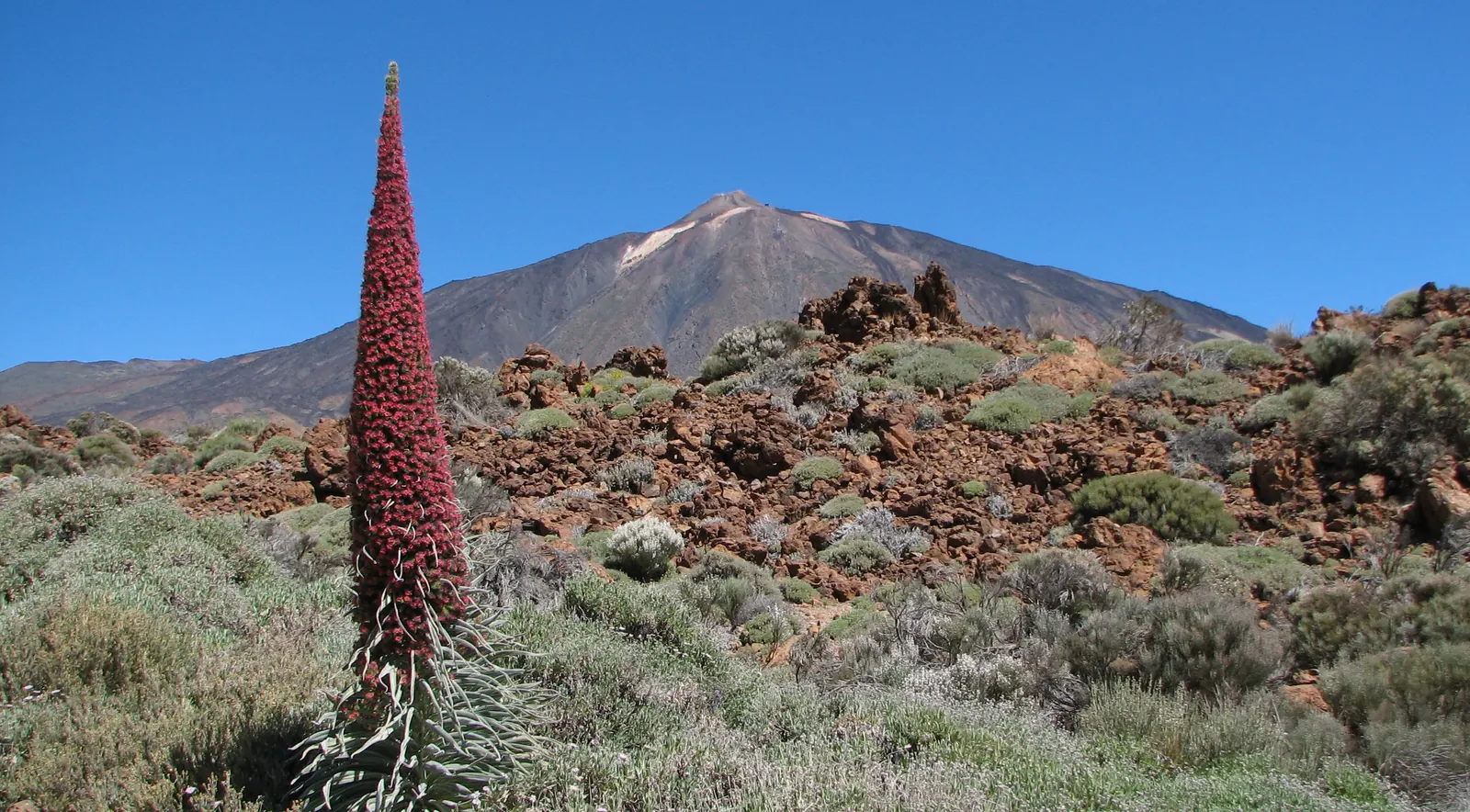
June has one thing the other summer months do not: the red tajinaste, a flower spike up to three metres tall that grows only in this park, usually flowers then. In summer, check the forest fire risk level on TenerifeON, the Cabildo’s official site for the island’s natural areas, before you walk any trail.
September: still dry, with fewer clear days
September is still dry, with highs around 19°C at the cable car base, and the long cable car hours run to the end of the month. The difference is the sky: about 17 clear days in an average September against 24 to 27 from June to August, so you are more likely to meet cloud over the park.
October to November: cooler and cloudier
Autumn brings more cloud and fog to the park, with 9 to 12 clear days a month, and highs fall from about 14°C in October to 11°C in November. The first snow can arrive in November. The cable car closes earlier once the clocks go back at the end of October, and sunset comes just after 18:00 by late November, so plan an earlier start.
December to March: snow on the peak, and the risk of closed roads
Winter is when Teide can be white. Izaña averages about two days with snowfall a month from December to March and 8 to 12 frosty days a month, and highs at the cable car base are only 8 to 10°C. On a clear day after snow the peak and the caldera turn white above the dark lava, and Spain’s park service describes the park as white in winter. The catch is access. Heavy snow closes the roads into the park: when storm Emilia brought snow in December 2025, the Cabildo controlled access from 19 to 22 December, and 5,536 people rode its free shuttle buses up over one weekend. Ice can also stop the cable car, which closes on 25 December in any case.
If you are visiting in winter, plan your Teide day early in your stay, so a closure leaves you other days to try, and check the road status before you set off. Our guide to driving to Teide covers which roads reopen first.
April to May: spring colour, cool mornings
Spring is milder, with highs of about 12°C in April and 15°C in May, and snow becomes rare after March, although frost is still possible on some nights. The park service describes the park as full of colour in spring, as the high-mountain shrubs flower on the caldera floor. Clear days rise from about 14 in April to 16 in May, about a third fewer than in summer, which makes May, with September, the next best month after June to August; the first tajinaste can flower late in May. In 2026 the cable car ran its longer hours over Easter.
Whatever the month, Teide National Park has more than one way in: sunset and stargazing evenings in the Las Cañadas caldera, the Teide cable car with a guide and hotel pickup, daytime visits to the Teide Observatory at Izaña, Roques de García on a park tour, and guided summit hikes with the permit arranged.
Weather on the Day and Cable Car Closures
On any one day, the weather in the park matters more than the month. Wind and ice close the cable car, often at short notice and in any season, so it is not something you can plan around weeks ahead. Cloud can sit over the caldera, and calima, the haze of Saharan dust that sometimes blows over the Canaries, can flatten the view in any month. The weather at your resort says little about any of this: it can be 25°C on the south coast while the caldera is cold and windy.
Two checks cover it. On the morning, Volcano Teide’s Teide Today page shows whether the cable car and trails are open, the weather at the upper station and live webcams. In winter, the Cabildo’s traffic map shows whether the TF-21, TF-24 and TF-38 are open.
What happens to your booking depends on what you bought. Cable car tickets bought from the operator can be moved or refunded free if it is closed, and you can change them until 18:00 the day before. Tours that include the cable car usually go ahead without it: the Mount Teide Tour with Cable Car Ticket & Transfer refunds the cable car part and takes an alternative route. If your booking has free cancellation, check the forecast before its deadline. The full terms are in when to book and what you can cancel, and what the ride gets you is in is the Teide cable car worth it?
The Best Time of Day, and How Busy It Gets
More than five million people visited Teide National Park in 2025, the most of any national park in Spain, and they came in roughly equal numbers in every season: between 24% and 26% of the year’s visitors in each of winter, spring, summer and autumn, according to Spain’s environment ministry. So no month gives you a quiet park. The day has a clear rhythm instead.
The two car parks most people want, at Roques de García and the cable car base, usually fill from about 10:00 and stay full until mid-afternoon, and weekends and the days after snowfall are worse. Volcano Teide says the first cable car hour, from 9:00 to 10:00, is the least busy, so an early start gives you a shorter queue and the morning at the viewpoints. Our guide to parking at Teide covers which car parks go first, and one day at Teide plans the day hour by hour.
Late afternoon is the other good window. The coaches leave, the car parks empty out, and sunset tours stay on for the light on the peak, Teide’s shadow over the sea of clouds when the sky allows, and then the stars. Sunset in the park runs from just after 18:00 in December to just after 21:00 in late June, in Canary time, so in summer a sunset trip is a late night.
Tajinaste Flowers and Stargazing
When the tajinaste flowers
The red tajinaste flowers in late spring. TenerifeON, the Cabildo’s guide to the island’s natural areas, puts the flowering in June, and some plants start in May. The spikes grow on the caldera floor around Roques de García and the Llano de Ucanca, and the timing moves from year to year with the winter rain and the cold, so treat it as a likely bonus of a June visit rather than a fixed date. Stay on the paths and leave the plants alone: everything in the park is protected.
When to go stargazing
The park lies inside a Starlight Reserve, and the sky is good in any month on a clear night. The moon matters most: near the new moon you see far more stars, while a bright moon washes out the faint ones. Summer adds two things. It has the most clear days, and from about June to September the bright centre of the Milky Way is in the southern evening sky, low over the horizon from this latitude. The Perseid meteors peak around 12 August. In winter the nights are longer and colder, with Orion high in the evening. The date checker above shows the moon for your night.
Teide Month by Month
| Month | Average high / low, cable car base | Clear days | Days with rain | Days with snow | Sunset, mid-month | What to expect |
|---|---|---|---|---|---|---|
| January: | 8°C / 1°C | – | 4.5 | 2.4 | 18:31 | Coldest month; snow and ice most likely, roads can close |
| February: | 8°C / 1°C | 13 | 4.0 | 2.5 | 18:57 | Snow and frost still common |
| March: | 10°C / 3°C | 13 | 4.1 | 2.1 | 19:15 | Last month with regular snow; days lengthening |
| April: | 12°C / 4°C | 14 | 2.7 | 0.6 | 20:31 | Milder; spring flowers begin; frost on some nights |
| May: | 15°C / 6°C | 16 | 1.1 | 0.2 | 20:49 | Usually dry; first tajinaste late in the month |
| June: | 19°C / 10°C | 24 | 0.2 | 0 | 21:04 | Tajinaste usually in flower; longest days |
| July: | 23°C / 14°C | 27 | 0.1 | 0 | 21:06 | Clearest and warmest month; cable car open later |
| August: | 23°C / 14°C | 24 | 0.5 | 0 | 20:46 | Warm and clear; Perseid meteors around 12 August |
| September: | 19°C / 10°C | 17 | 1.6 | 0 | 20:12 | Still dry and mild; fewer clear days than summer |
| October: | 14°C / 7°C | 12 | 3.7 | 0.2 | 19:38 | More cloud and fog; clocks go back at the end of the month |
| November: | 11°C / 5°C | 9 | 4.4 | 0.6 | 18:14 | Few clear days; first snow possible |
| December: | 9°C / 2°C | 11 | 5.6 | 1.6 | 18:13 | Snow season begins; cable car closed on 25 December |
The temperatures and day counts are long-term averages for Izaña, at the height of the cable car base on the park’s eastern rim; the caldera floor is a little lower and the upper station about 1,200 metres higher and colder. A clear day is one with little or no cloud through the day, and no January figure is published. Sunset is calculated for Las Cañadas on the 15th of each month, in Canary time.
Which Tour Suits Your Dates
For a summer evening, or any clear night near the new moon, Sunset and Stargazing at Teide National Park is the one we would book: rated 4.7/5 from 3,730 reviews, from $39, three to five hours with optional hotel pickup, and it arrives as the daytime crowds leave. The closest alternative was the Teide National Park Sunset & Stargazing Tour, with more reviews (4,658) but a lower rating of 4.2 and a higher price. If you want dinner included, Volcano Teide’s Guided Sunset & Stargazing Tour by Night with Dinner runs nine hours (4.7/5 from 1,556 reviews, from $99).
For a daytime visit with the cable car, the Mount Teide Tour with Cable Car Ticket & Transfer comes from the company that runs the cable car (4.3/5 from 6,156 reviews, from $103). Its practical advantage in a windy week is that the day still goes ahead if the cable car is closed, with that part refunded. If you would rather see more of the island in winter, when the park can be cold, the Teide National Park, Masca, Icod & Garachico Tour combines the caldera with lower villages (4.6/5 from 3,095 reviews, from $65). For the summit itself, the permit sets your date: see the Teide summit permit guide.
Best Time to Visit Teide: Your Questions
What is the best month to visit Mount Teide?
If your dates are flexible, June to August offers the best overall balance, with the clearest and driest weather of the year in the park and average highs of about 19 to 23°C at the height of the cable car base. June is the single month to choose, because the red tajinaste usually flowers then. May and September come next: still dry, but with about a third fewer clear days.
Can you visit Mount Teide in winter?
Yes. The park is open every day and tours run all winter. December to March is when snow can cover the peak, but it is cold, with average highs of 8 to 10°C at the cable car base, and heavy snow can close the roads into the park for a day or more. Check the road status and the cable car status on the morning you go.
How cold is it at the top of Mount Teide?
At the height of the cable car base, average highs run from about 8°C in January to 23°C in July, and winter nights are often below freezing. The upper station is about 1,200 metres higher, so it is several degrees colder again and often windy. If you are riding the cable car, pack a warm, windproof layer even when it is 25°C on the coast; for a summer day on the caldera floor alone, a light layer is usually enough.
How often is the Teide cable car closed?
It closes on 25 December and whenever wind or ice make it unsafe, often at short notice and in any month, so it is not something you can plan around in advance. Check Volcano Teide’s Teide Today page on the morning; tickets bought from the operator can be moved or refunded free if it is closed, and tours that include it refund that part and visit other areas of the park.
What is the best time of day to visit Teide?
Early. The main car parks are usually full from about 10:00 to 15:00, and the cable car opens at 9:00, so arriving before 10:00 avoids the busiest hours. Late afternoon is the other good choice: the car parks empty out and sunset tours stay on for the light and the stars.
When does the tajinaste flower on Teide?
In late spring. The Cabildo’s TenerifeON guide puts the flowering of the red tajinaste in June, and some plants start in May. The timing moves from year to year, so treat it as a likely bonus of a June visit rather than a fixed date.
When is the best time for stargazing at Teide?
Any clear night near the new moon is good, in any month. Summer has the most clear days at park level, and from about June to September the bright centre of the Milky Way is in the southern evening sky. A bright moon washes out faint stars, so check the moon for your date as well as the forecast.
Sources and Methodology
Where each figure comes from, and where the evidence stops
- Climate: AEMET, Spain’s state weather agency, normal values for Izaña (station C430E, 2,369 m), reference period 1981–2010, read 13 October 2026: average highs and lows, days with at least 1 mm of rain, days with snow, frosty days, foggy days and clear days. AEMET publishes no clear-day figure for January. The coastal comparison is AEMET Tenerife Sur airport (C429I, 64 m), 1981–2010, where July highs average 27.7°C. Temperatures are rounded to the nearest degree. The cooling with height uses the standard atmosphere, about 6.5°C per 1,000 metres.
- Visitors: Spain’s Ministry for the Ecological Transition (MITECO), Visitantes a los Parques Nacionales Españoles. Año 2025 (May 2026): 5,113,021 estimated visitors to Teide National Park, and its seasonal shares of all national-park visits (winter 8.07%, spring 7.68%, summer 8.24%, autumn 8.35%, of a park total of 32.34%), which make 23.7% to 25.8% of Teide’s own visitors per season. The report groups December with January and February.
- Cable car: Volcano Teide’s prices and opening times page (2026 timetable in seven dated bands, opening at 9:00), read 13 October 2026; its booking terms for closures and changes, and its statements that the cable car closes on 25 December and that the first hour is the least busy, as checked for our booking guide and one-day plan.
- Snow and roads: RTVC, 21 December 2025, on storm Emilia, the access control from 19 to 22 December and the 5,536 shuttle passengers; the Cabildo de Tenerife’s traffic map at cic.tenerife.es.
- Park and flowering: MITECO’s Teide National Park page (white in winter, full of colour in spring, arid in summer); TenerifeON, “Tajinaste (Echium) flowering season”, 15 May 2023.
- Car parks: our parking guide, from Tenerife ON’s parking information and visitor reports.
- Sunset, moon and Milky Way: calculated for Las Cañadas (28.23°N, 16.64°W) with the NOAA solar algorithm on the 15th of each month of 2027, in Canary time (UTC, or UTC+1 from the last Sunday of March to the last Sunday of October); the moon from the mean lunar cycle. Times are accurate to a few minutes.
- Tours: GetYourGuide listings, ratings, review counts and prices, read 13 October 2026.
- Date checker forecast: the Open-Meteo model forecast for the park’s coordinates and elevation, read live in your browser.
- Hero photo: “Teide y tajinaste (Echium wildpretii)” by javiersanp, via Wikimedia Commons, licensed CC BY-SA 3.0; cropped.
Where the evidence stops:
- The climate figures come from one station on the park’s rim and from 1981–2010; a 1991–2020 table for Izaña was not on AEMET’s public pages when we checked. They describe a typical month, not a forecast.
- No one publishes how many days the cable car or the roads close each month, so the winter pattern rests on the snow-day averages and on dated closures, not on a count.
- The visitor figures are estimates for the whole park by season, for one year; the series does not count cable car passengers or busy hours.
- The tajinaste’s timing changes every year and no body publishes a forecast for it.
- Volcano Teide had not published its 2027 timetable when we checked, so the date checker gives the 2026 pattern for later dates.
- There is no month-by-month price series for Teide tours, so the page says nothing about cheaper months.
More on Planning a Teide Day
The cable car, the permit, the day itself and getting there.
- Is the cable car worth it?What the ticket gets you at 3,555 m, and what to do when wind closes it.
- One day at TeideAn hour-by-hour plan, the cable car timings and one-day car hire.
- When to book and cancelThe summit permit 56 days out, the cable car a few days before.
- Parking at TeideEvery car park, when each fills, and the fines for getting it wrong.
- Driving to TeideThe four roads, and which reopens first after snow.
- Teide summit permit 2026How TenerifeON works, the fee tiers, and the Monday-morning release.